A team of 20 experts brainstorms your problem. Then 14 personas try to destroy every idea.
What survives is genuinely worth building.
Brainstormer is a 6-phase multi-agent pipeline that explores broadly, abstracts deeply, recruits domain specialists, stress-tests with diverse personas, and delivers a ranked shortlist of your best ideas — with scores, provenance, and concrete first steps.
No credit card · 3 free sessions · Results in minutes
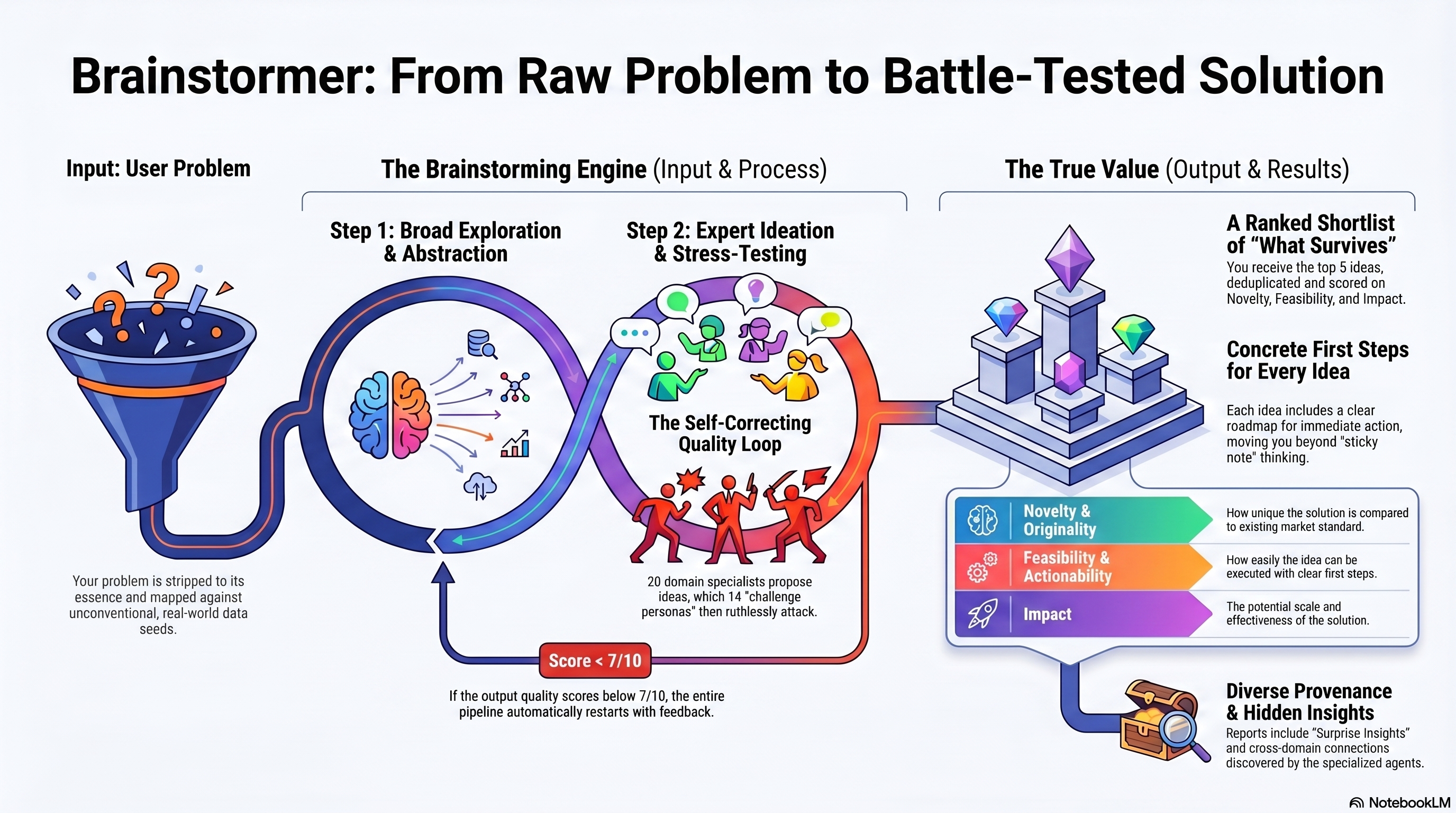
Click image to enlarge
Explore
Web search · Random seeds · Divergent mapping
Abstract
Pattern discovery · Structural analogies · Hidden laws
Reframe
Inverted · Analogy · Constraint-shifted · 10× version
Ideate
4 specialists from 20 · Concrete domain ideas
Stress-Test
Creative review · 4 personas challenge every idea
Rank
5 dimensions · Deduplicated · Scored & ranked
Watch a full Brainstormer session — from raw challenge to ranked, stress-tested ideas
Human brainstorming has a ceiling.
Groups think they're creative, but research shows they converge too fast, miss entire domains, and never stress-test what they produce. Brainstormer fixes every gap.
Groups converge too fast
Phase 1 forces broad divergence: web search, random seeds, killer questions, and abstract pattern discovery — before a single idea is generated.
Domain blind spots
20 specialists span engineering, science, medicine, law, psychology, design, economics and more. A random wild-card ensures you always check a field you'd never think to.
Ideas are never stress-tested
The Creative Reviewer runs 5 structured tests (Da Vinci, Blind Spots, Constraint Flip, Combination, Knowledge Gap). Then 14 personas attack from completely different worldviews.
Surface-level thinking
The Abstractor strips your problem to its mathematical essence — feedback loops, power laws, phase transitions — and finds structural analogies in completely different domains.
No way to compare ideas
Every idea is deduplicated and scored on 5 weighted dimensions: Novelty, Feasibility, Impact, Originality, and Actionability. You get ranked results, not a pile of sticky notes.
One-pass and done
A Pipeline Reviewer scores the entire output. If quality < 7/10, the pipeline loops with targeted feedback injected into every agent — genuine self-correction, not repetition.
8 structured steps. Zero guesswork.
Brainstormer mimics how the best human thinkers work: explore broadly, abstract deeply, bring in specialists, stress-test ruthlessly, then rank what survives.
Phase 1 — Divergent Exploration
Explorer
Searches the web for unconventional approaches, injects random cross-domain seeds, and maps the full possibility space around your topic.
Killer Questions
Generates 8–10 provocative questions: assumption-challengers, inversions, perspective shifts, and "pre-built solution" checks.
Absorption
Distills the exploration map + killer questions into 3–5 focused entry points — the most promising starting angles.
Abstractor 🧠
Strips the problem to its abstract essence. Finds structural analogies in distant domains, hidden patterns (power laws, feedback loops, phase transitions), and pre-built solutions.
Phase 2 — Reframing
Reframer
Presents the problem 5–6 ways: inverted, analogy-based, constraint-shifted, stakeholder-shifted, root-cause, and 10× version — giving specialists multiple angles of attack.
Phase 2.5 — Selection
Specialist Selector
Reviews all 20 specialists, picks 3 by relevance + calls a tool for 1 random wild-card. Only 4 actually run — the rest are skipped via gate callbacks.
Phase 3 — Ideation
Specialists × 4
Each selected specialist proposes 2–3 concrete ideas grounded in their domain expertise. Reads all upstream context: exploration map, abstraction, reframed topics, and review feedback.
Phase 4a — Review
Creative Review 🧠
Runs 5 structured stress-tests: Da Vinci Test, Knowledge Gap, Blind Spots (vs. killer questions), Constraint Flip, and Combination. Proposes 2–3 NEW ideas from the gaps found.
Phase 4b — Personas
Persona Challenges × 4
4 personas (from a pool of 14) each pick the BEST idea, skewer the WORST, and propose one idea only their worldview would generate. Catch what specialists share as blind spots.
Phase 5 — Evaluation
Evaluator 🧠
Deduplicates all ideas (specialists + creative review + personas), scores each on 5 dimensions using a weighted scoring tool, and produces a final ranked list.
Phase 6 — Synthesis
Synthesizer
Delivers Top 5 Ideas (title, score, description, first step), a Surprise Insight (unexpected cross-domain connection), and What's Missing (area for deeper investigation).
Loop Gate
Pipeline Reviewer
Scores the full output on 4 dimensions (relevance, diversity, quality, surprise). If average ≥ 7: exits. If < 7: writes targeted improvements injected into every agent for iteration 2.
20 specialists generate. 14 personas destroy.
For every session, 4 specialists are dynamically selected (3 by relevance + 1 random wild-card). Then 4 personas stress-test from radically different worldviews.
Specialist Pool — 20 Domain Experts
Mechanical Engineer
Physical systems, mechanisms, manufacturing
Chemical Engineer
Materials, reactions, energy systems
Electrical Engineer
Circuits, IoT, signal processing
Systems Architect
Complex systems, scalability, interfaces
Data Scientist
ML, statistics, pattern recognition
Software & AI Engineer
AI pipelines, automation, cloud
Physicist
First-principles, quantum, energy
Biomedical Researcher
Biology, biotech, human factors
Persona Pool — 14 Challenge Archetypes
The Millionaire
ROI & scale
The Skeptic
Prove it works
Curious Child
"But why?"
The Artist
Beauty & emotion
The Futurist
10-year horizon
The Historian
Tried before?
Devil's Advocate
Argue the opposite
End-User Advocate
Simplicity & UX
Environmentalist
Planet-first
Ethics Watchdog
Fairness & bias
Rigorous Scientist
Where's the data?
The Regulator
Is it legal?
Global South Voice
Resource-constrained
The Philosopher
First principles
Dynamic Selection + Random Wild-Card
The Selector agent reads the full roster and picks 3 specialists by relevance to your topic. Then it calls a randomness tool to add 1 wild-card from a completely unrelated domain. Same process for personas. This ensures you always get deep domain expertise plus at least one perspective you'd never have chosen yourself.
Not a list of suggestions. A Brainstorming Report.
Every session produces a structured, scored, traceable output — with the thinking behind every idea fully documented.
Exploration Map
Cross-domain connections, random seed ideas, and the full possibility space mapped before any brainstorming begins.
Killer Questions
8–10 provocative questions that challenge your assumptions — these are checked against every idea later in the pipeline.
Abstract Pattern Analysis
The hidden structure beneath your problem: structural analogies from distant fields, feedback loops, power laws, and pre-built solutions.
Specialist Ideas
Concrete, domain-grounded ideas from 4 experts across orthogonal fields — each scored and explained.
Top 5 Ranked Ideas
Deduplicated, scored on 5 dimensions (Novelty, Feasibility, Impact, Originality, Actionability), with a concrete first step for each.
Surprise Insight + Gap
One unexpected cross-domain connection the pipeline discovered, plus one area flagged for deeper investigation.
See a real Brainstormer output
Topic: “How might we reduce food waste in urban restaurant supply chains?” — here's what the pipeline delivered.
Micro-Composting Concierge Network
Environmental ScientistDeploy neighbourhood-scale composting micro-hubs at restaurant back doors — a concierge logistics layer collects, processes locally, and sells compost to urban farms within a 2-km loop.
Predictive Spoilage Routing
Data ScientistML model trained on POS data + weather + delivery schedules predicts which inventory items will spoil within 48h and auto-routes them to discount partners or food banks before waste occurs.
Behavioural Menu Architecture
Behavioural PsychologistRedesign digital menus using loss-aversion framing: show the environmental cost of waste beside each dish and use default portion sizing based on historical consumption patterns.
Enzyme-Accelerated Bio-Digesters
Chemical EngineerCounter-top bio-digesters using engineered enzyme cocktails break food waste into liquid fertiliser in 24h — restaurants sell it as branded "urban soil" to local gardeners.
Supply-Chain Trophic Cascade Model
Systems ArchitectMap the restaurant supply chain as an ecological trophic cascade — identify keystone intervention points where a single change (e.g., standardised container sizes) reduces waste across multiple tiers.
Give it any challenge. Watch it think.
From startup product ideas to research questions to creative challenges — Brainstormer finds angles you wouldn't reach alone.
"What new product opportunities exist at the intersection of aging and wearable technology?"
Selected Specialists:
Pipeline Highlight:
The Neuroscientist proposed cognitive load monitors for early dementia detection. The Behavioural Psychologist suggested habit-loop wearables for medication adherence. The Curious Child persona asked "why can't grandma's watch just tell the doctor she's sick?"
"How can we make remote team collaboration feel more spontaneous and human?"
Selected Specialists:
Pipeline Highlight:
The Abstractor found this is fundamentally a "serendipity engineering" problem — same structure as urban planning for chance encounters. The Systems Architect proposed digital "watering holes" with physics-based proximity signals.
"What are unconventional approaches to reducing employee burnout in high-pressure industries?"
Selected Specialists:
Pipeline Highlight:
The Historian found that medieval guild apprenticeship rhythms prevented burnout through structured variety. The Environmental Scientist drew parallels to forest fire prevention — controlled burns as "preventive rest episodes."
"How could principles from game design make public transportation more appealing?"
Selected Specialists:
Pipeline Highlight:
The Evaluator scored "progression loop commuter levels" highest on actionability. The Ethics Watchdog persona caught a gamification bias that would penalise low-income riders.
"How might we improve literacy rates in rural communities with limited internet access?"
Selected Specialists:
Pipeline Highlight:
The Global South Voice persona reframed the entire idea set around SMS-based and radio-based delivery. The Education Specialist proposed spaced-repetition audio lessons broadcast on community FM stations.
"How can we reduce microplastic contamination in freshwater systems?"
Selected Specialists:
Pipeline Highlight:
The Abstractor identified this as a "distributed filtration at network nodes" problem — same structure as internet packet filtering. The Chemical Engineer proposed enzyme-functionalized biofilms that selectively bind microplastics at wastewater outflows.
"How can a traditional retail bank compete with fintech challengers for Gen Z customers?"
Selected Specialists:
Pipeline Highlight:
The Futurist persona projected that by 2035 "bank" means embedded finance, not branches. The Business Strategist proposed a "financial API layer" — let Gen Z build their own banking UX on top of the bank's infrastructure.
"How do we design a museum exhibit about climate change that doesn't make people feel hopeless?"
Selected Specialists:
Pipeline Highlight:
The Artist persona pushed for "agency architecture" — every exhibit station ends with a concrete action the visitor takes before moving to the next room. The Physicist contributed a real-time carbon-feedback installation using live data.
Not “ask ChatGPT for ideas.”
Single-prompt brainstorming produces average ideas that cluster together. Brainstormer is architecturally designed to prevent that.
Deep Abstraction Layer
The Abstractor (a reasoning model) strips your problem to its mathematical essence and finds structural analogies in completely different domains. This is the "aha moment" engine — it's what separates mediocre brainstorming from breakthrough thinking.
Most powerful agent in the pipelineWeb-Grounded Exploration
The Explorer and Abstractor both use Google Search to anchor ideas in real-world patterns — not just LLM training data. They search for the abstract version of your problem, finding cross-domain solutions that actually exist.
Real-time web search in 2 phasesControlled Randomness Injection
Random seed generators force unexpected cross-domain connections. Wild-card specialists and personas ensure you always check a field you'd never choose yourself. Structured chaos, not noise.
3 randomness tools across the pipeline5-Test Creative Review
Before evaluation, ideas face the Da Vinci Test, Knowledge Gap check, Blind Spot audit (against killer questions), Constraint Flip, and Combination test. Ideas that pass all five are genuinely robust.
Reasoning model for deep analysisAnti-Drift Guardrails
Every agent has "STAY ANCHORED" constraints and word limits. The pipeline flows through a funnel — broad exploration → focused entry points → concrete ideas — preventing the topic drift that plagues long AI sessions.
Architectural constraint, not prompt hackSelf-Correcting Loop
The Pipeline Reviewer scores on 4 dimensions. If quality < 7/10, it writes specific improvement notes that are injected into every agent's prompt on iteration 2. The pipeline literally learns from its own output.
Up to 2 iterations with targeted feedbackAnyone with a hard problem and no time for bad ideas.
Startup Founders
Explore product ideas, new markets, and unconventional features — with specialist-level thinking across 20 domains, before spending a cent on build.
Generate your first product idea setInnovation & R&D Teams
Run structured innovation sprints with scored, ranked, traceable idea portfolios. Replace whiteboard Post-its with quantified decision-ready outputs.
Run a Brainstormer innovation sprintStudents & Researchers
Explore research questions across disciplines. The Abstractor finds structural parallels in fields you'd never check — opening entirely new research angles.
Explore a research questionStrategy Consultants
Deliver higher-quality ideation to clients. 20 expert perspectives + 14 stress-test personas in minutes, not days. Each idea scored and defended.
Augment your next strategy sessionProduct Managers
Go beyond feature requests. Brainstormer finds the abstract problem behind user pain points and generates solutions from engineering, psychology, economics, and design.
Brainstorm your next feature setSocial Enterprises & NGOs
The Global South Voice, Ethics Watchdog, and Environmentalist personas ensure ideas work for resource-constrained, equity-focused contexts — not just Silicon Valley.
Generate impact-focused ideasTypical AI Brainstorming
- ✕Single prompt → single response
- ✕Ideas cluster around obvious solutions
- ✕No stress-testing or critique
- ✕No structural abstraction
- ✕No scoring or ranking
- ✕No web grounding
- ✕No iteration or self-correction
Brainstormer
- ✓13+ specialised agents in a structured pipeline
- ✓Forced diversity: 20 specialists × 14 personas × random wild-cards
- ✓5-test Creative Review + persona challenges
- ✓Deep Abstractor finds hidden patterns & structural analogies
- ✓Scored on 5 dimensions, deduplicated, ranked
- ✓Google Search grounds ideas in reality
- ✓Pipeline Reviewer loops with targeted feedback if quality < 7/10
20 specialists. 14 personas. 6 phases. One report.
Stop brainstorming alone.
Let a team of experts think with you.
Give it your hardest problem. Get back ranked, scored, stress-tested ideas with concrete first steps — in minutes.
First session free · No credit card · Results in minutes